Plan routine changes
Convert 10%, 20%, 25%, 30%, 50%, or any other percentage into liters, US gallons, or UK gallons.
Calculate the exact amount of water to replace for a routine change, or estimate the change needed to lower nitrate to a target level.
Convert 10%, 20%, 25%, 30%, 50%, or any other percentage into liters, US gallons, or UK gallons.
Use current nitrate, target nitrate, and source-water nitrate to calculate the required one-time change.
Compare the replacement volume with the water left in the aquarium before preparing buckets or containers.
Aquarium water change guide
Use the routine mode when you already know the percentage you want to replace. Use nitrate reduction mode when a test result and target should determine the change. The source-water nitrate field keeps the dilution estimate realistic when tap or prepared water is not nitrate-free.
100 L of water, starting at 40 ppm nitrate, with replacement water at 10 ppm. Each change removes 50 L after complete mixing. Assumes no additional nitrate production or uptake between changes. On small screens, swipe the table sideways to see all columns.
| Stage | Water replaced this stage | Predicted nitrate | Original tank water remaining |
|---|---|---|---|
| Before changes | — | 40 ppm | 100% |
| After first change | 50 L (50%) | 25 ppm | 50% |
| After second change | 50 L (50%) | 17.5 ppm | 25% |
For a routine change, the calculator multiplies aquarium volume by the selected percentage. A 25% change in a 100 liter aquarium therefore requires about 25 liters of prepared replacement water.
For nitrate reduction, the calculator uses dilution: required fraction = (current nitrate - target nitrate) / (current nitrate - source-water nitrate). This estimates the result of one well-mixed water change without additional nitrate being produced during the change.
Choose Lower nitrate, enter 100 L tank volume, 40 ppm current nitrate, 20 ppm target, and 10 ppm source-water nitrate. The required fraction is (40 − 20) ÷ (40 − 10) = 0.6667. The calculator shows about 66.7 L, or 66.7%, for one well-mixed change.
The target of 20 ppm is an example for the calculation, not a universal livestock target. A large result tells you how much dilution the numbers require; it does not decide the safest timing or replacement-water chemistry for your aquarium.
Two 50% changes do not replace 100% of the original water. After the first change, half remains; after the second, half of that half remains. In the example table, nitrate falls from 40 to 25 to 17.5 ppm. Although 100 L has passed through a 100 L tank, 25% of the original water remains.
For equal changes, the ideal estimate is source nitrate + (starting nitrate − source nitrate) × (1 − fraction changed) raised to the number of changes. This formula assumes complete mixing and unchanged source water, with no nitrate produced or consumed between stages. Real spaced changes need new measurements.
The calculator handles one change at a time. To reproduce the table, use Lower nitrate with current 40, target 25, source 10; then use current 25, target 17.5, source 10. Both give 50%. In practice, re-test after mixing and use the actual new reading before recalculating.
Replacement water can only dilute aquarium nitrate toward its own nitrate level. If source water contains 10 ppm nitrate, one water change cannot lower the aquarium below 10 ppm without using a lower-nitrate source or another suitable treatment method.
Test tap, RO mix, or prepared water when the aquarium does not fall as expected after a change. Seasonal source-water changes and test variation can affect the result.
A calculation above 50% is not automatically wrong, but it deserves extra care. Match temperature and relevant chemistry, use conditioner where required, and consider whether a staged approach is safer for sensitive livestock. Retest and recalculate between stages because several smaller changes do not produce the same dilution as one large change.
Visible distress, contamination, ammonia, or nitrite can require urgent action that a routine calculator cannot diagnose. Follow appropriate emergency or treatment guidance instead of waiting for a perfect percentage.
Record the amount changed, nitrate before and after, source water, conditioner, temperature, and any filter or substrate work. Repeated results show whether the routine is keeping up with feeding, stocking, and waste production.
If nitrate repeatedly returns faster than expected, review feeding, livestock load, plant growth, maintenance frequency, and source water rather than increasing the percentage blindly.
FAQ
No. With complete mixing, two 50% changes leave 25% of the original tank water. For 40 ppm nitrate and 10 ppm replacement water, the predicted readings are 25 ppm after the first and 17.5 ppm after the second, assuming no production or uptake between changes.
Multiply the aquarium volume by 0.25. A 100 liter aquarium needs about 25 liters, while a 40 US gallon aquarium needs about 10 US gallons.
Subtract the target nitrate from the current nitrate, then divide by current nitrate minus source-water nitrate. Multiply that fraction by tank volume to get the replacement volume.
Enter the measured source-water nitrate. The calculator will account for it and warn when the target is below what that source water can reach in one change.
Not normally. A partial change removes only the same fraction of nitrate, and replacement water may add some nitrate back. A 50% change with nitrate-free water roughly halves the reading.
For sensitive livestock or mismatched source water, staged changes may reduce abrupt temperature, pH, KH, GH, or TDS shifts. Retest and recalculate between stages because several smaller changes do not equal one large change. Emergencies and treatment instructions can require a different response.
No. The nitrate mode is a dilution planning tool. Detectable ammonia, nitrite, contamination, or livestock distress needs prompt situation-specific action and repeated testing.
Related aquarium planning
Use the calculator result with logs, guides, and maintenance tools so one number becomes part of a repeatable aquarium care routine.
Other tools
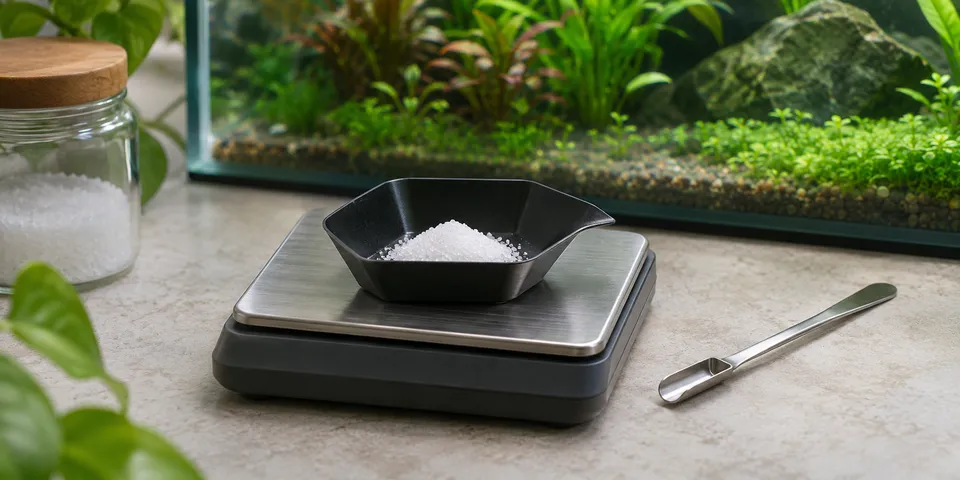
Calculate dry KNO3, KH2PO4, K2SO4, magnesium, and trace doses from editable weekly ppm targets.
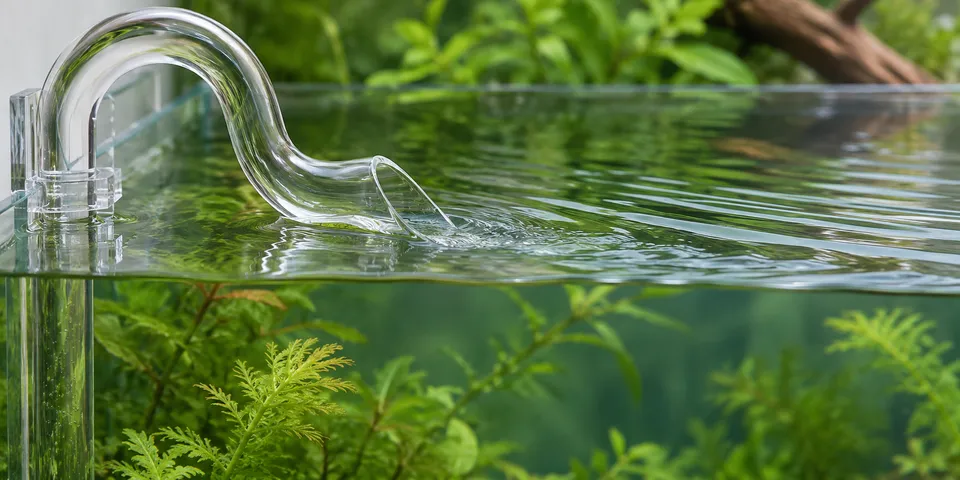
Compare delivered flow with filter or display-circulation planning ranges.
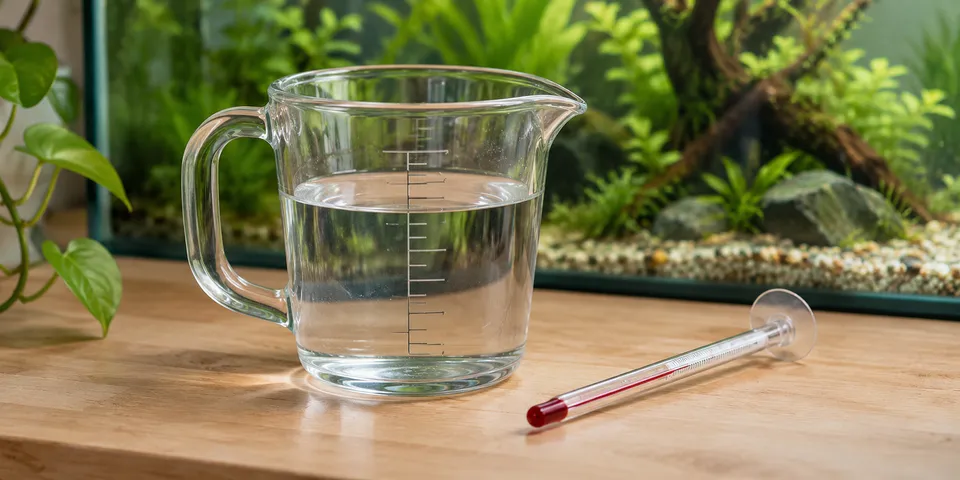
Convert aquarium volume, temperature, length, flow, GH, and alkalinity.
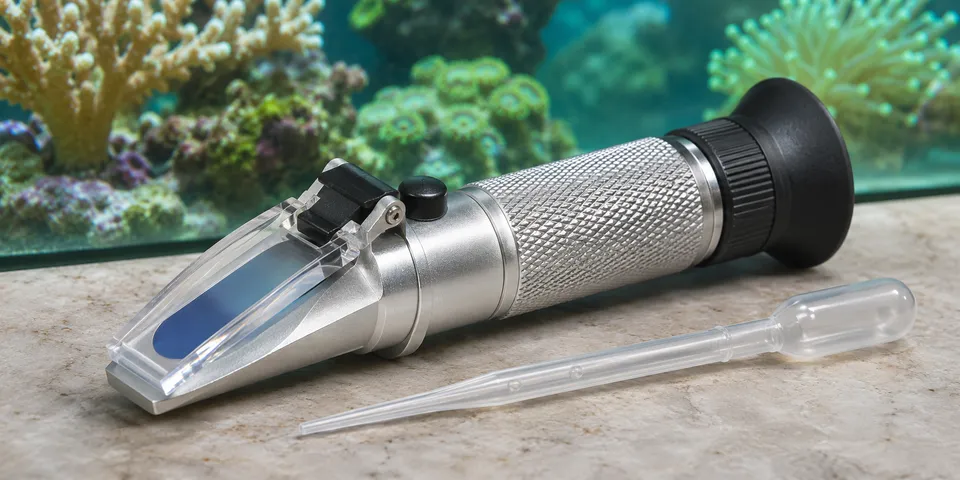
Convert specific gravity and practical salinity with temperature context.
Scale product directions for a new batch or plan separately mixed correction water.
Estimate electricity, replacement water, and recurring aquarium expenses.
Explore aquarium planning tools for tank setup, stocking, aquascaping, nutrients, and planted tank care.
Build a fish list and compare estimated stocking, adult size, temperature, pH, and temperament.
Get the app
Download on iOS or Android to log water tests, plan maintenance, and get reminders on the go.
4.837 ratings
4.647 ratings
Cookies & analytics
We use cookies to understand how Aquarium Tracker is used. You can decline non-essential tracking and the site will keep working.